
SightLogix Logo
 

Using GPS Video Analytics for Accurate Perimeter Intrusion Detection

In the outdoors, trying to accurately detect perimeter intrusions over large areas can be like looking for a needle in a haystack. Moving foliage, wind, weather, even ripples in water can trigger nuisance alarms.

GPS positioning data plays a vital role in reducing perimeter security nuisance alarms.The key is to select intelligent videos cameras that have been designed from the ground up to be inherently “geo-registered.” This means that the camera’s field of view (FOV) maps the GPS coordinates of all points in the landscape under surveillance. Such an approach is fundamental to achieving high performance and accuracy in an intelligent video surveillance system.

For indoor surveillance where distances are small, geo-registration is not as important. But think about the outdoors, where blowing trash, moving leaves or small animals will constantly cross the camera’s view. In these cases, knowing an object’s actual size becomes more important.

That’s because cameras lack depth perception. To an outdoor camera, a small object that’s close to the camera will appear substantially larger than a person standing off in the distance. Without GPS details, the camera will likely ignore the human in the distance and send alarms for the closer objects. As a result, the system will generate an overwhelming number of nuisance alarms and quickly lose all accountability.

On the other hand, when an intelligent video camera uses GPS location information to monitor a scene, the camera can make very accurate decisions based on the size of all detected objects. GPS-based analytics allows the camera to filter the small animal while still detecting the human-sized intruder in the distance. When such cameras are designed with sufficient image processing to clean up the other outdoor issues (motion from wind, changing lighting, clutter from foliage, and weather), the result is comprehensive security.

Geo-registration, which can also be used to automatically steer PTZ cameras to track and follow targets, also has a direct impact on lowering project costs while leading to an installation that’s on time and on budget. We’ll return to this important topic in the future, so subscribe to the blog and never miss an update.

Related posts

Print Print | Email Email

Outdoor Video Security Webinar

SightLogix is presenting an Outdoor Video Surveillance webinar on Thursday, July 22, 2010, at 1 p.m. Eastern Time (10 a.m. PT; 11 a.m. MT; Noon CT, 6 p.m. GMT). The webinar will discuss how intelligent video surveillance designed for the outdoors can improve security for large outdoor facilities and perimeters.

Register at www.sightlogix.com/surveillance-webex-registration.html.

Webcast topics include:

  • The use of outdoor surveillance systems to detect, track and identify intrusions
  • Understanding the sources of nuisance alarms and how to prevent them
  • The value of obtaining precise location information about a target
  • The impact of camera range and detection accuracy on overall solution costs

Webcast Details

When: Thursday, July 22, 2010
Time: 1:00pm ET (10 AM PT; 11 AM MT; 12 PM CT; 6 PM GMT)
Register: www.sightlogix.com/surveillance-webcast-registration.html

Hope to see you there.

Print Print | Email Email

Addressing Camera Blind Spots in Perimeter Security Design

The folks over at Chemical Facility Security News make an important comment on using Google Maps for designing a perimeter security layout.  We certainly agree that walking a site is the best way and only way to understand the nuances of a perimeter’s terrain. Ultimately, a good security design requires a real-world, on-site evaluation. It’s a good point and we thank them for making it.

Even so, SightSurvey is helpful for building good security concepts into a final site design. For instance, it can highlight the need to address the area under the pole — the so-called “dead zone” — which remains a security concern regardless of real-world terrain conditions. This is particularly important for securing large areas, such as chemical storage facilities, refineries, or transportation assets, because as you narrow the camera’s field of view to cover longer distances, the blind spot under the camera grows.

Importantly, each camera in a perimeter layout must address the dead zone of the next camera along the perimeter, and this area only increases as the distance covered by each camera expands.  Consider that a camera twenty feet off the ground using a seven degree field of view may have a blind zone as long as 60 meters.

A modeling tool like SightSurvey — while not a replacement for a real-world evaluation – can still play an important role in making sure that these important design gaps are appropriately addressed.

Related posts

Print Print | Email Email

Design a Perimeter Intrusion Detection System with Google Maps

SightSurvey was designed to help integrators quickly and easily model an outdoor area and perimeter security layout around an actual site.  It’s become one of our most popular design tools.

SightSurvey uses Google Maps to create an intelligent video camera layout on any facility. This lets you address typical security design issues — like camera blind spots and terrain conditions — and determine areas of vulnerability or coverage gaps. By using Google Maps, you can gain a close approximation of the final design requirements even before you visit or walk the area.

With SightSurvey, you can set pole height, view blind spots under the camera, and choose visible or thermal intrusion detection cameras based on the application environment. Even large facilities such as airport perimeters, rail yards or seaports can be designed in a few minutes.

SightSurvey also lets you plan the number of cameras and their optimal placement, and determine a camera’s range for different sized object detection, such as a person versus a vehicle. You can also use SightSurvey to compare the number of cameras required for effective video intrusion detection around your facility.

We’ve put together a brief overview of SightSurvey, which you can watch below.  If you like what you see, register for SightSurvey here.

Related posts

Print Print | Email Email

Welcome to the SightLogix Blog

Welcome to the SightLogix Blog. Our goal is to help you learn how intelligent video can best be used to secure outdoor areas and facility perimeters.

If this is your first visit, we recommend subscribing for email updates or RSS feed.

Print Print | Email Email

Thoughts on the 2010 SIA Government Summit

Security Industry Association

Last week’s SIA Government Summit in Washington was a terrific event. I was impressed by the depth of the discussions, and came away with a sense of confidence that the government leaders who presented have a solid grasp on the issues regarding the security of the nation’s critical assets.

I continue to be impressed by the SIA’s Government Relations Program, particularly their role as an advocate for our industry. One important example is their impact to successfully eliminate the matching requirement for the 2010 Port Security Grant Program.  Removing this requirement is a credit to the SIA’s advocacy and bodes well for our national security efforts and those who serve the security market. Tax payers also benefit when the government expeditiously places funds where they are greatly needed.

Another takeaway from the summit was my sense of the market’s recovery. This opinion was expressed when speaking with our partners and it’s certainly a trend we’ve been experiencing in recent months. The perception is that funds are flowing from the American Recovery and Reinvestment Act, a positive sign for the market’s recovery, which appears to be building momentum.

Print Print | Email Email

Automatically Steer PTZ Cameras to Track and Follow Targets

When it comes to protecting outdoor areas, security professionals often have two main concerns:  Not being aware of the risks that are lurking, and not knowing the place and nature of an intrusion should one occur.

Intelligent video cameras address the first concern by leveraging the inherent strengths of automated systems and people. Smart cameras never tire, can cover large distances, and “see” what the eye would miss. People can then be counted on to make response decisions.

It’s this second concern — the “what and where” of an unfolding event — that has been more difficult to address. Typically, a perimeter intrusion detection system will combine several technologies, including fixed cameras for long-range surveillance and PTZ’s to zoom and follow an object for more detail. The problem is that there’s almost no chance the PTZ cameras will be looking in the right place when an intrusion occurs. Trying to manually locate a detected alarm with a PTZ camera — especially over large outdoor areas — can be like finding a needle in a haystack.

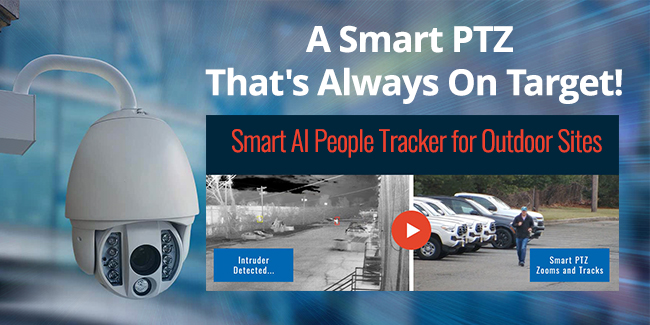
The better way is to use systems that capture GPS positioning data, which is then used to steer PTZ cameras to automatically track and zoom in on intruders, making the target large enough to reliably identify. This information can also be used as forensic recording for post-event management.

You can see this in action in the following video.  Each video panel displays one element of a video intrusion detection system. The left panel shows a visible detection camera; the center panel shows a wide-area camera; the right panel shows a thermal camera, and the bottom right panel shows the PTZ. You’ll see how it is automatically steered to zoom and follow the target, which is simultaneously displayed onto the topology map on the bottom left.

Such automatic control is especially valuable for facilities that monitor large areas with long-range detection cameras.

If you liked this post, subscribe to the SightLogix RSS feed or sign up for email updates.

Related posts

Print Print | Email Email

Reducing Perimeter Security Nuisance Alarms: Finding Targets Against a Moving Background

Intrusion Detection System in a Moving BackgroundIn our continuing series for reducing perimeter security nuisance alarms we’ve addressed the benefit of image processing and the value of electronic image stabilization. Another requirement for accurate perimeter intrusion detection is for an automated camera to “see” security violations against a background of movement and clutter. Practically speaking, this means the camera must be smart enough to ignore movement from “unimportant” objects. Such movement is also known as non-salient motion.

By definition, non-salient motion comes from objects that always return to the same position within a brief period of time, like branches, trees, foliage, or reflections in water. Alternatively, salient or “important” motion comes from objects that traverse the camera’s field of view, like a person or vehicle.

From a security perspective, salient motion is what matters. It’s activity that likely represents a legitimate intruder entering a secure area which requires investigation. On the other hand, non-salient motion is normal behavior in the outdoors, and must be filtered by the camera or the nuisance alarm rate will reach a level so high they will likely be ignored.

For indoor surveillance applications, such distinctions are irrelevant because background objects are not moving. In the dynamic outdoors the differences between these two types of motion is more important. Think of a typical outdoor scene: a large tree will sway in the breeze within the same general location. The same thing happens with leaves, bushes or reflections in water. Obviously, you want such movement to be ignored, or risk wasting your security efforts chasing after phantom issues.

Filtering such movement is best accomplished with sufficient on-board processing and video memory buffers for making the right determination. This is no easy task, especially considering the amount of data that a camera needs to analyze over a large outdoor scene spanning hundreds of meters. Importantly, when we refer to “video memory buffers” we’re not talking about on-board video storage for future retrieval. In this case, we’re talking about very high-speed memory that’s used for real-time scene analysis.

For example, a large tree takes a period of time to move in one direction and then just as long to return. Cameras that lack sufficient memory will only see the tree moving one way and trigger an alert. On the other hand, if the camera can analyze and store scene information over a longer period of time it can conclude that such background movement returns to the same area and is an “unimportant” object to be ignored.

You can see a real-world example of an intelligent video surveillance camera accurately determining salient from non-salient motion in the following video. Notice how the moving brush and foliage on the left is safely ignored, along with the heat waves coming off the vehicle, while the human targets — which are actually smaller than some of the background objects that are ignored — are accurately detected and alarmed. In fact, this video also shows how intelligent video cameras can “see” what the human eye may have missed.

Without sufficient on-board processing and video analysis memory to filter non-salient motion, such an environment would most likely be overwhelmed with nuisance alerts.

Subscribe to the SightLogix blog and keep updated on this series and other articles related to outdoor security.

Related posts

Print Print | Email Email

Dansette